Key Research Findings at a Glance
- Consistent Benefits: Blue-enriched classroom lighting (6500K, 250+ melanopic EDI) improves attention test scores by 8-35% and reading speed by 10-34% across multiple controlled trials
- Age-Specific Effects: Preschoolers show executive function improvements; elementary students gain reading fluency; adolescents need careful timing to avoid sleep disruption
- Optimal Dosing: Target 250-500 melanopic EDI lux at eye level during morning classes, tapering to moderate levels (150-250) in afternoons
- Limited Impact: Comprehension and motivation show minimal changes; benefits are task-specific, favoring attention-dependent activities
- Implementation: Success requires measuring vertical illuminance at eye level, not just CCT or horizontal lux; timing matters as much as intensity
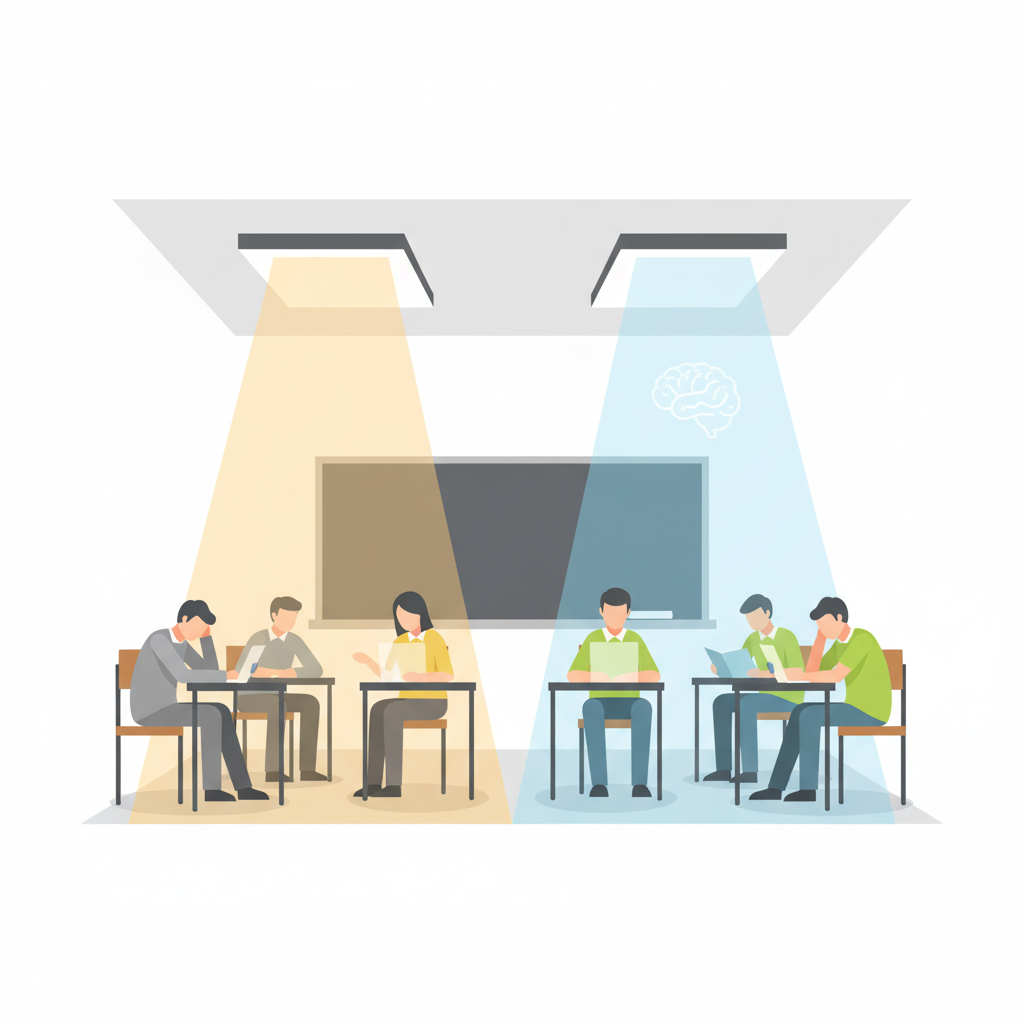
The lighting in your classroom can be the difference between engaged learning and afternoon fatigue. Beyond "how bright," the spectral content and timing of light—especially short‑wavelength, melanopic‑rich light that stimulates ipRGCs—affect alertness, attention, and some learning‑relevant tasks. Systematic reviews and classroom field trials show daytime bright or blue‑enriched light tends to increase alertness and speed on attention‑heavy tasks, with more modest or mixed effects on higher‑order comprehension.
Note: "Blue‑enriched"/high CCT is a crude proxy. Best practice is to target melanopic EDI (M‑EDI) per CIE S 026 rather than CCT alone.
What Makes Light "Educational"?
Educational lighting goes beyond visual acuity. It aims to deliver the right dose, spectrum, and timing to support alertness and circadian alignment while maintaining visual comfort. The CIE S 026 framework defines melanopic metrics for humans and recommends reporting vertical light at the eye (melanopic EDI, melanopic DER/MDER).
- Melanopic EDI (M‑EDI): Daylight‑equivalent illuminance (D65) producing the same melanopic stimulus. CIE S 026 toolbox and Manchester explainer.
- EML vs. M‑EDI: EML (legacy WELL metric) and CIE M‑EDI are closely related; convergent literature shows a near‑constant scaling between them and recommends using M‑EDI going forward.
- CCT provides only a rough estimate of biologically effective light—different spectra at the same CCT can vary in melanopic potency by 20-40% depending on how manufacturers achieve that color temperature.
The Research Landscape: From K–12 to University
K–12 Classrooms: Attention and Reading Speed
Several field trials using dynamic/high‑CCT light with elevated vertical illuminance report improvements in attention and reading fluency, with weaker or null effects on comprehension and motivation. Representative studies: the 9‑month German "variable light" trial (Barkmann et al.), Dutch dynamic‑lighting experiments (Sleegers et al.), and a U.S. grade‑3 trial with a high‑illuminance/6500 K "Focus" preset (Mott et al.).
German 9‑Month Classroom Trial
Variable illuminance & CCT across the day vs. standard fluorescent lighting.
- Fewer omission errors (attention test)
- Higher reading speed; comprehension ↑ not statistically significant
Barkmann et al., 2012
Netherlands Dynamic‑Lighting Studies
3 studies with vertical 350–1000 lx; CCT 3000–12 000 K.
- Positive effects on pupils' concentration in two quasi‑experimental field studies and one lab study
Sleegers et al., 2013
U.S. Grade‑3 "Focus" Lighting
~1000 lx, ~6500 K scene during reading instruction vs. standard lighting.
- Oral reading fluency improved vs. control
- No effect on motivation or concentration
Mott et al., 2012
Secondary School Blue‑Enriched Trial
Morning blue‑enriched white light vs. standard classroom lighting.
- Faster processing & better concentration (d2 test)
- No memory benefit; some students rated brightness less "just‑right"
Keis et al., 2014
Preschool: Executive‑Function Benefits
In preschoolers, higher‑CCT classroom lighting improved task‑switching (cognitive flexibility) without changing sustained attention. Hartstein et al., 2018.
University / Young Adults: Alertness and Memory (esp. when sleep‑restricted)
Daytime short‑wavelength‑enriched/high‑melanopic light reliably increases subjective alertness and often speeds vigilance/processing. Under sleep restriction, some studies show memory/working‑memory benefits. Representative examples: Grant et al., 2021; systematic review/meta‑analysis Siraji et al., 2022. For more on how these effects translate to workplace environments, see our article on blue-enriched light effects on workplace cognitive performance.
Daylight as a Performance Driver (Large Field Data)
Multi‑district analyses from Heschong‑Mahone linked classroom daylighting to faster learning gains in math and reading, though re‑analyses and critiques caution about confounds. Use daylight for biologically meaningful exposure, but interpret academic correlations carefully. Heschong, 1999; Windows & Classrooms, 2003; critique context: ACEEE, 2002; LRC review summary in Figueiro et al., 2016 (citing Boyce).
Understanding Melanopic Metrics in Education
Modern practice specifies melanopic EDI (vertical at the eye) and MDER (melanopic daylight efficacy ratio). For a comprehensive overview of the foundational research behind these metrics, see our analysis of 1500 research papers on melanopic lighting. A simple design rule is:
melanopic EDI ≈ photopic vertical lux × MDER
Example: 300 lx vertical with MDER ≈ 0.85 (blue‑enriched) → ~255 melanopic lx. See measurement/validation guidance: Trinh et al., 2023.
Melanopic Ratio Comparison: Typical LEDs vs. Innerscene Circadian Sky
Note: Most conventional LED fixtures are limited to 6500K maximum, while Innerscene's Circadian Sky extends to 40,000K, providing melanopic ratios up to 1.53—exceeding natural daylight (D65 = 1.0). The 20-40% variation in melanopic output at the same CCT is shown by the shaded range for typical fixtures.
How much is "enough" in the day? What to avoid at night?
- Consensus guidance: target around ≥250 melanopic EDI during the day and ≤10 melanopic EDI in the evening, with very low levels at night. CIE TN 015:2023; complementary expert guidance in Brown et al., 2022.
- Do not rely on CCT alone—while CCT provides a rough indicator, two light sources with the same CCT can vary by 20-40% in melanopic potency depending on their spectral composition. Always verify with actual melanopic metrics. Esposito & Houser, 2022; CIE Position Statement, 2024.
- WELL Standard historically used EML and now provides M‑EDI equivalence for compliance; typical credit thresholds include ~200–250 EML for day settings (context‑dependent). WELL Circadian Lighting.
Translating Research to Practice
Morning Activation Strategy
Studies most consistently find benefits with morning blue‑enriched/high‑melanopic light. Consider a "Focus/Energy" scene early in the day delivering around ≥250 melanopic EDI at student eye level, then transitioning to neutral scenes after late morning to protect evening sleep—especially for adolescents.
Task‑Appropriate Lighting
- Reading & testing: many trials used cooler, brighter scenes (e.g., ~6500 K with higher vertical illuminance) and observed faster reading/attention. Mott 2012; Keis 2014; Sleegers 2013.
- Creative/collaborative work: warmer/lower‑melanopic scenes help maintain comfort without suppressing evening melatonin carry‑over. CIE TN 015:2023.
- Afternoons: moderate melanopic levels help counter post‑lunch dips without encroaching on evening sleep. Acute daytime alerting effects are task‑dependent and sometimes null at high baseline light. Souman et al., 2018 (review); Smolders et al., 2018 (dose‑response).
Quick Spec Translation
If an LED scene provides MDER = 0.60 and vertical photopic illuminance of 420 lx at the eye → M‑EDI ≈ 252 melanopic lx (meets the daytime target).
Age‑Specific Findings
Light sensitivity and circadian response vary significantly across age groups. While this review focuses on school-age populations, it's worth noting that older adults require dramatically more blue light exposure due to age-related changes in the eye's lens (see our article on why seniors need 5X more blue light).
| Age Group | Stronger Effects | Weaker/Null Effects | Notes |
|---|---|---|---|
| Preschool (3–5) | Task‑switching / executive function | Sustained attention | Hartstein 2018 |
| Elementary (6–11) | Reading speed, attention | Reading comprehension, motivation | Mott 2012; Sleegers 2013 |
| Secondary (12–18) | Processing speed, concentration | Memory consolidation | Keis 2014; Studer 2019 |
| University (18–25) | Alertness, working memory (esp. sleep‑restricted) | Complex reasoning (tasks often mixed) | Grant 2021 |
Mixed Results & Why Some Studies Fail
- Task dependency & baseline light: many daytime studies raise subjective alertness but show small or null effects on complex cognition, especially when baseline light is already high.
- Insufficient melanopic dose or poor timing: benefits are strongest with morning exposures around the 250 melanopic lx range; evening exposure risks sleep disruption in adolescents.
- Spectrum vs. illuminance confounding: many classroom trials change both; use M‑EDI/MDER to decouple.
Recent Controlled Evidence on "How Much" (Melanopic Dose)
A controlled crossover study in healthy adults compared ~250 vs. ~150 melanopic lx (≈50‑min exposure). It found higher subjective alertness at ~250 m‑EDI, similar task concentration across time, and slightly poorer contrast sensitivity under the blue‑enriched condition (small magnitude, likely not functionally important), alongside higher comfort relative to a very high‑CCT workplace precedent. Gagné et al., 2024.
The Critical Role of Glare Control and Light Distribution
Why Surface Area Matters: The Luminance Problem
While achieving adequate melanopic EDI is essential, how that light is delivered matters just as much as the quantity. The human eye responds not just to illuminance (lux at the eye) but to luminance—the brightness of the light source itself (measured in candelas per square meter, cd/m²).
Common Glare Sources in Educational Settings
1. Solar Tubes and Skylights
While solar tubes efficiently bring daylight into classrooms, their small aperture creates extreme luminance contrasts. Research from the Heschong Mahone Group (2003) found that clear skylights sometimes negatively impacted student performance—with a 21% decrease in reading scores due to glare issues. Diffusing skylights performed better, distributing light over a larger apparent surface area and improving reading by 19% and math by 20%.
2. Downlights and Spot Lighting
Traditional downlights concentrate high luminous flux through small apertures (typically 4-6 inches), creating:
- Direct glare when viewed at angles >45° from nadir
- Reflected glare on glossy surfaces like tablets and whiteboards
- Cave effect with bright spots on desks but dark vertical surfaces
- Luminance ratios exceeding 10:1 between task and surround (recommended maximum is 3:1)
3. Unshielded Linear Fixtures
Exposed T8/T5 fluorescent or LED strips create a "line of fire" effect—high luminance along the lamp axis that causes discomfort when in the peripheral vision field.
The UGR Standard and Comfort Thresholds
The Unified Glare Rating (UGR) quantifies discomfort glare, with EN 12464-1 specifying UGR ≤19 for classrooms. This translates to practical luminance limits:
| Light Source Type | Typical Luminance | UGR Impact | Comfort Rating |
|---|---|---|---|
| 6" Downlight (LED) | 8,000-15,000 cd/m² | UGR 22-26 | Uncomfortable |
| Clear Solar Tube | >20,000 cd/m² | UGR >28 | Very Uncomfortable |
| 2×2 Panel (Diffused) | 3,500-5,000 cd/m² | UGR 16-19 | Comfortable |
| 2×4 Panel (Diffused) | 2,000-3,000 cd/m² | UGR 14-17 | Optimal (direct only) |
| Indirect/Direct Pendant* | 2,000-3,000 cd/m² | UGR 12-16 | Optimal (if surfaces allow) |
Note: Both 2×4 panels and indirect/direct pendants achieve optimal comfort with UGR <19. The indirect/direct option adds better vertical illuminance and room uniformity but at higher cost. 2×4 panels offer the best value for direct lighting applications.
The Uniformity Paradox: While excessive uniformity (>0.8) can feel sterile and "institutional," moderate uniformity (0.6-0.7) prevents eye strain from constant adaptation. Natural daylight creates 10:1 to 100:1 variations, but in task-oriented spaces like classrooms, uniformity ratios of 3:1 (0.33) to 2:1 (0.5) balance visual comfort with spatial interest. Adding accent lighting, wall washing, or daylight integration can prevent the "flat" feeling while maintaining functional uniformity.
*Note on Indirect Lighting Limitations:
• Space constraints: Impractical in large spaces (>1000 sq ft) or with ceiling heights >12 ft due to inverse square law losses
• Surface dependency: Indirect lighting assumes white/light ceilings (reflectance >0.8). Real classrooms often have:
- Acoustic tiles with 0.5-0.7 reflectance (30-50% light loss)
- Exposed structure, pipes, or HVAC reducing effective reflection area
- Wall coverage with posters, bulletin boards, whiteboards (reducing wall wash effectiveness)
- Windows and doors creating "light leaks" instead of reflection
- Darker accent walls or painted surfaces (reflectance <0.5)
• Practical solution: Most classrooms benefit from 70/30 or 60/40 direct/indirect ratios rather than pure indirect, ensuring adequate task lighting regardless of room surfaces while still reducing glare.
Comfortable Illuminance Depends on Distribution
Research shows that acceptable illuminance levels vary dramatically based on light distribution quality:
- With high-glare sources (downlights, clear skylights, solar tubes): People prefer lower levels (300-400 lux) to minimize discomfort
- With well-distributed sources (large panels, indirect): Comfortable up to 750-1000 lux
- With optimal distribution (indirect/direct combinations): Can exceed 1000 lux without discomfort
Best Practices: Achieving 250+ Melanopic EDI Without Glare
Practical Implementation: Evidence‑Based Classroom Design
- Target morning vertical M‑EDI ≈ ≥250 at eye height (~1.2 m seated) 08:00–12:00; taper later. Use glare‑controlled daylight plus blue‑enriched electric scenes with appropriate MDER.
- Exploit daylight first for basal melanopic dose, then supplement for seasonal consistency; interpret academic correlations with caution.
- Timing controls: AM high‑melanopic scenes; moderate afternoons; low‑melanopic evenings in teen study spaces (≤10 m‑EDI within ~3 h of bedtime). For detailed timing protocols, see our melanopic light exposure guidelines.
- Measure & report vertical M‑EDI and MDER at commissioning; follow ENLIGHT reporting guidance in research/pilots. ENLIGHT, 2023.
- WELL compliance: if pursuing WELL, document M‑EDI/EML equivalence under L03. WELL Circadian Lighting.
The Bottom Line: Light as a Learning Tool
The research demonstrates that classroom lighting significantly affects student performance, particularly in attention-dependent tasks. While effects on higher-order comprehension are more modest, the consistent benefits for alertness, processing speed, and reading fluency make melanopic lighting a valuable educational tool. Similar evidence exists for clinical populations—see our review of melanopic lighting in behavioral health settings for complementary research.
Success requires precision: ≥250 melanopic EDI during morning hours, task-appropriate spectral content, and careful timing that enhances days without disrupting sleep. Advanced lighting systems that can deliver high CRI/wide-spectrum light, flicker-free 40kHz output, low glare design, accurate daylight colors, and automated scheduling make this precision achievable in real classrooms.
References (linked)
- Barkmann, C., Wessolowski, N., Schulte‑Markwort, M. Applicability and efficacy of variable light in schools (2012).
- Sleegers, P. et al. Lighting affects students' concentration positively: findings from three Dutch studies (2013).
- Mott, M. S. et al. Illuminating the Effects of Dynamic Lighting on Student Learning (2012); SpringerPlus replication (2014).
- Keis, O. et al. Influence of blue‑enriched classroom lighting on students' cognitive performance (2014).
- Studer, P. et al. Effects of blue‑ and red‑enriched light on attention and sleep in adolescents (2019).
- Hartstein, L. E. et al. A brighter classroom boosts preschoolers' executive function (2018).
- Grant, L. K. et al. Daytime exposure to blue‑enriched light counters sleep restriction effects (2021).
- Siraji, S. M. et al. Systematic review/meta‑analysis: daytime electric light, alertness & higher cognition (2022).
- Gagné, V. et al. Evaluating ~250 vs. ~150 melanopic lx in a controlled setting (2024).
- Ricketts, E. J. et al. Electric lighting, adolescent sleep & circadian rhythms (narrative review) (2022).
- Heschong‑Mahone Group. Daylighting in Schools (1999); Windows & Classrooms (2003); critique ACEEE 2002.
- CIE S 026 resources: α‑opic Toolbox User Guide; Manchester explainer.
- Esposito, T., & Houser, K. CCT is not a suitable proxy for melanopic content (2022).
- Brown, T. M. et al. Recommendations for daytime/evening/nighttime indoor light (2022).
- CIE TN 015:2023. Proper Light at the Proper Time (workshop consensus).
- CIE Position Statement (3rd ed., 2024). Recommending Proper Light at the Proper Time.
- WELL Standard—Circadian Lighting (L03). Feature page.
- Trinh, V. Q. et al. Determination & measurement of melanopic EDI (2023).
- ENLIGHT consensus checklist. eBioMedicine (2023).
- Souman, J. L. et al. Acute alerting effects of light (systematic review) (2018).
- Smolders, K. C. H. J. et al. Dose–response daytime light & executive control (2018).
For Healthcare and Lighting Professionals: Interested in implementing evidence-based educational lighting? Contact Innerscene to learn how our research-backed Circadian Sky systems deliver the precise melanopic levels and timing protocols validated in educational research, with high CRI/wide-spectrum light, flicker-free 40kHz output, low glare design, accurate daylight colors, and automated scheduling.